OPC vs CIP isn’t a choice made on the factory floor. By the time a line is running, the equipment has already decided: an open conveyor can’t be CIP’d, a sealed tank can’t be hand-scrubbed. The real decision happens earlier, when equipment gets specified, or later, when someone has to work out whether it’s worth the capital to convert equipment.
That earlier decision gets revisited far less often than it should. Sites keep running open equipment as OPC and closed equipment as CIP for years after the product mix, volumes or risk profile have moved on, without ever asking whether the physical form still matches the job. Here’s what each method actually is, how they compare, and where that design-table decision genuinely sits.
The core difference between OPC and CIP
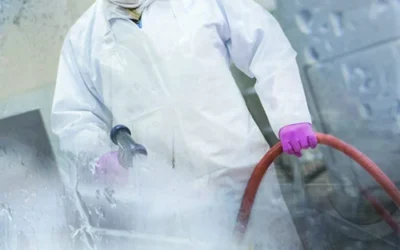
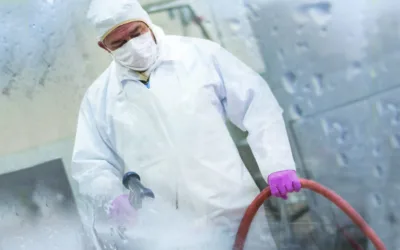
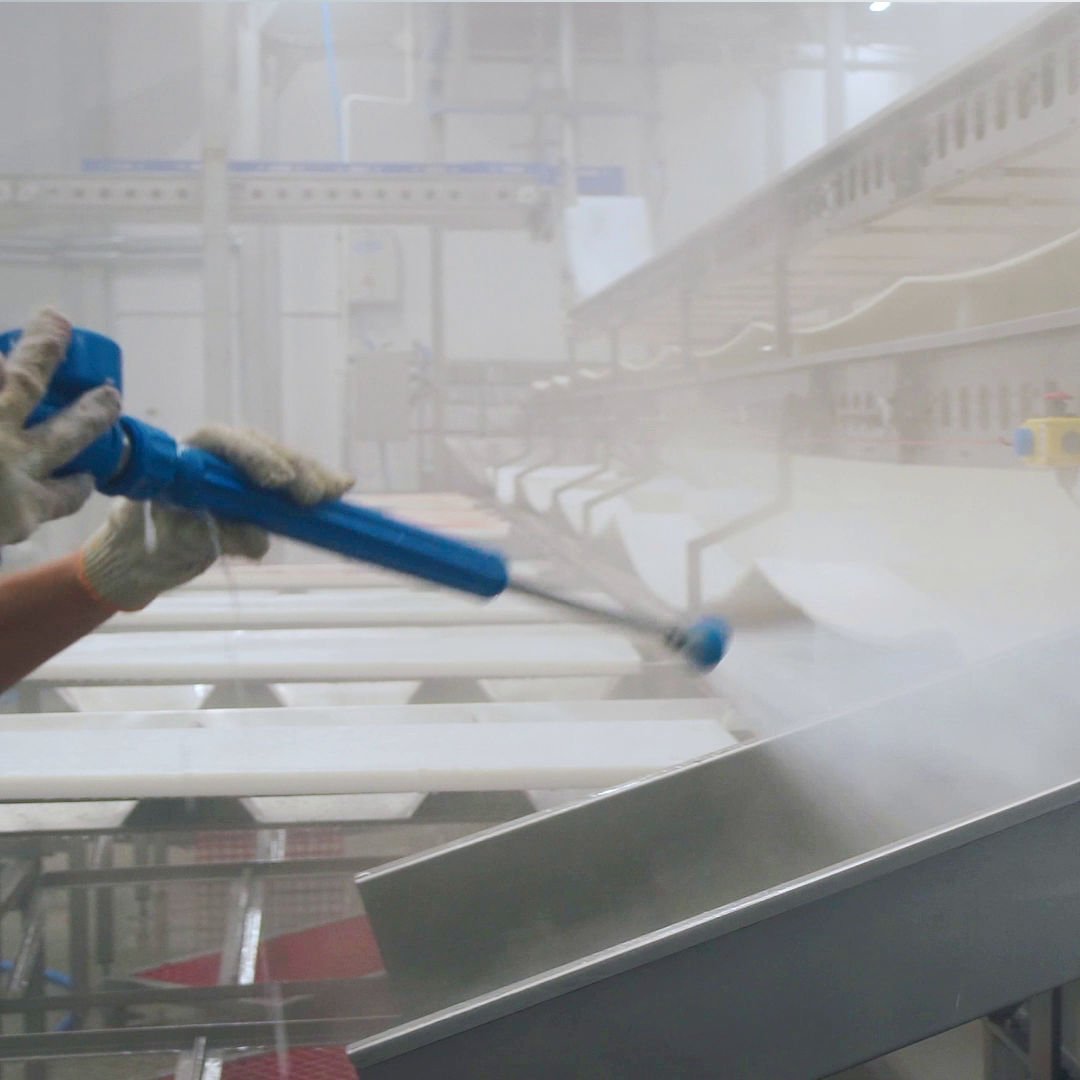
Open plant cleaning (OPC) is the manual cleaning and disinfection of open surfaces: floors, walls, tables, conveyors, external machine frames and dismantled parts. The mechanical force comes from people, brushing, scrubbing, pad work, spray impact.
CIP is the cleaning of closed vessels, tanks, pipelines and enclosed product circuits without dismantling the equipment, and with little or no manual involvement. The mechanical force comes from turbulence, flow velocity and impingement from spray devices.
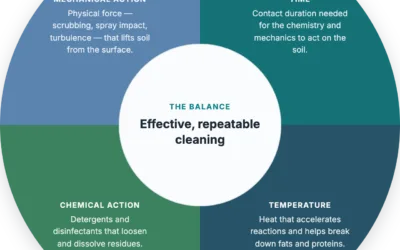
Both still run on the same underlying model. Time, temperature, chemistry and mechanical action all have to balance for either method to actually work, which is why the theory behind Sinner’s Circle applies just as much to a CIP recipe as it does to a hand-scrubbed floor. What changes between OPC and CIP is where that mechanical action comes from, and how much visibility you have into whether it actually happened.
When OPC is the right call
OPC fits any equipment that’s genuinely open: conveyors, external frames, cutters, tables, walls, drains, floors and small parts that get dismantled for cleaning. It’s also the right method wherever frequent visual inspection matters, or where a high-changeover operation needs to demonstrate that visible soil or allergen residue has actually been removed rather than just chemically treated. If someone needs to look at a surface and confirm it’s clean, OPC gives you that in a way a sealed pipe never will.
When CIP is the right call
CIP is built for closed vessels, tanks, pipelines, heat exchangers and enclosed product circuits, exactly the equipment where manual access is difficult or impossible without a lengthy strip-down. It also earns its keep on high-frequency, repetitive cleaning where automation, repeatability and auditable records matter, and anywhere dismantling would create downtime the schedule can’t absorb.
Done well, CIP takes a lot of the human factor out of the equation. Chemical dilution is controlled by the system rather than a person with a jug, which lowers manual intervention and the associated handling risk. It’s also far better suited to data capture: conductivity, temperature, flow and time can all be logged automatically, which supports recipe validation in a way that’s harder to achieve when a person is doing the scrubbing.
OPC and CIP Comparison

The advantage of each method only holds if it’s managed properly. OPC’s advantage is that you select it for accessibility and get direct visual proof; managed badly, it leaves hidden soil or drags out downtime. CIP’s advantage is standardisation and auditability; managed badly, low ownership or poor training quietly breaks the process anyway, and a beautifully logged recipe means nothing if the hydraulics were never validated against the equipment they’re running through.
The failure mode is the same either way: mistaking the record for the result
A CIP system can log perfect concentration, flow and temperature data while the spray device coverage misses a section of pipe entirely. An OPC crew can foam and rinse on schedule every single time and never actually scrub. Both look compliant on paper. Neither one is proof of a clean surface. That gap between what was recorded and what actually happened is exactly the territory covered in our article on the most common OPC cleaning mistakes in food manufacturing, and it applies just as much to a CIP set as it does to a hand-scrubbed conveyor or table.
The OPC vs CIP decision isn’t something a hygiene team makes each shift. It’s set the moment equipment gets specified. But it isn’t fixed forever either. Product changes, equipment ages, throughput requirements shift, and a physical form that was the right call five years ago can quietly become the wrong one to keep running as-is. The sites that get the most out of either approach are the ones that periodically ask whether their equipment still deserves the method it was built for, and that verify the outcome rather than assuming the design decision made years ago is still the right one.
If you’re weighing whether an ageing line still deserves the method it was built for, or whether your current OPC or CIP process is delivering what it should, talk to our team today to discuss your options for a more effective and efficient cleaning system.