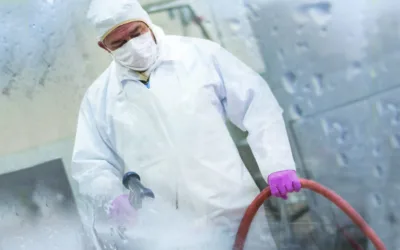
Two sites can buy the exact same detergent, run the exact same contact time, and get completely different results from their open plant cleaning (OPC). The difference almost never comes down to the chemical. It comes down to whether the site understands, and actually applies, the model that governs every hygiene operation: Sinner’s Circle.
It’s not a new idea. But it’s one of the most consistently ignored principles in food factory hygiene, and understanding it properly is the fastest route to a cleaning programme that actually works instead of one that just looks like it does.
What Sinner’s Circle says
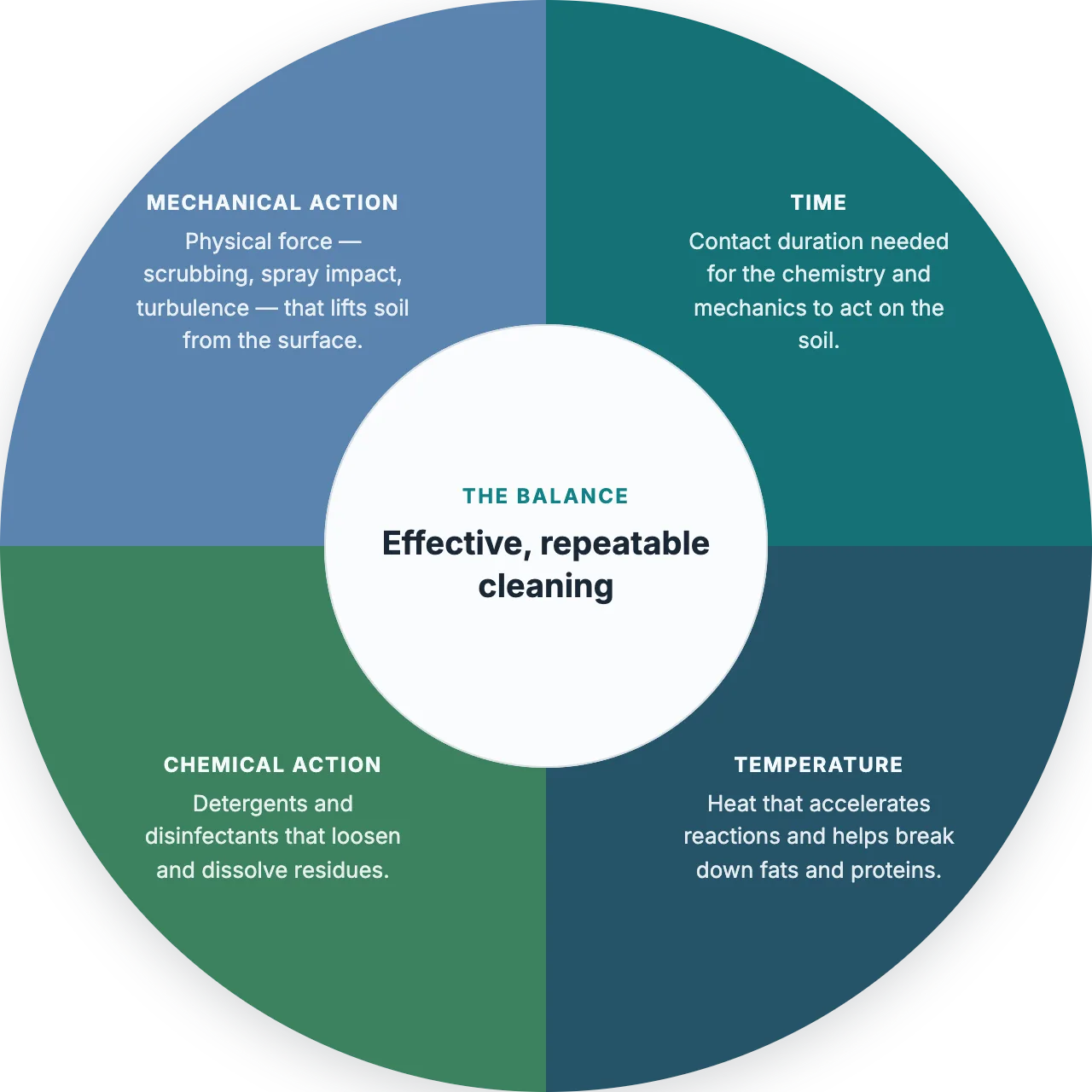
Sinner’s Circle describes cleaning performance as the product of four interacting factors: time, temperature, chemistry and mechanical action. None of them work in isolation. Turn one down, and one or more of the others has to increase to get the same result. Turn one up without adjusting for it, and you can waste money, damage equipment or still fail to get a clean surface.
Time is how long the water, detergent or sanitiser stays in effective contact with the soil. It should match what the chemical supplier specifies, not what fits the shift pattern.
Increasing Temperature speeds up fat removal and improves detergent action, but push it too far and you can bake protein onto a surface instead of removing it, on top of burning through energy and stressing seals and gaskets.
Chemistry determines what soil can actually be shifted. Alkaline detergents break down fats and proteins, acids handle mineral scale, sanitisers reduce microbial load once the surface is already clean. Each does a different job, and none of them substitutes for another.
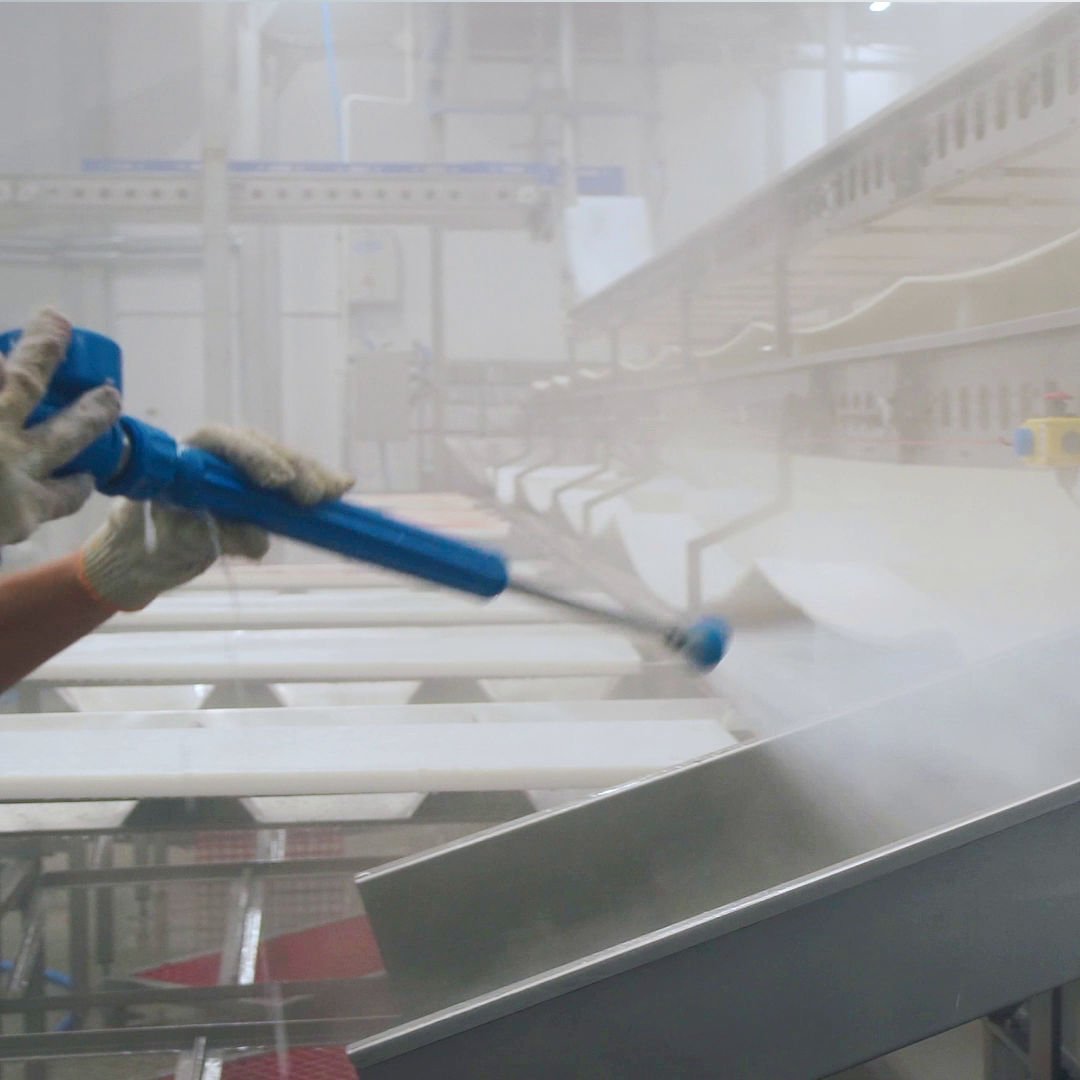
Mechanical action is the one that gets cut first under time pressure, and it’s usually the one that matters most. In OPC, that means brushing, scrubbing, pad work and spray impact. In CIP it’s turbulence and flow velocity. Either way, it’s the physical force that actually lifts soil off a surface rather than just softening it.
Where OPC goes wrong in practice
Open plant cleaning covers floors, walls, tables, conveyors and machinery surfaces, both food contact and non-food contact, following a sequence: gross debris removal, pre-rinse, detergent application, mechanical action, rinse, sanitising, a final rinse if required, and verification.
The theory is straightforward. The challenge is what happens under real factory conditions. The most common failure we see is a site leaning almost entirely on foam and contact time while quietly dropping mechanical action to near zero, because scrubbing is slower and harder work than waiting. Chemical suppliers themselves say mechanical input is often required. It gets skipped anyway, and the gap gets papered over with longer dwell times or hotter water, neither of which touches the actual problem.
Ventilation is a challenge that gets far less attention than it deserves. High-temperature water and high-pressure hoses, especially in a chilled environment, generate mist and condensation, and in a poorly ventilated space that condensation becomes a persistent environmental microbiology risk, Listeria in particular. It’s entirely possible to generate a condensation problem even without high pressure or high temperature, simply through poor extraction. Managing it isn’t a side issue to cleaning. It’s part of getting Sinner’s Circle right, because a site fighting condensation is usually a site that’s over-relying on heat to compensate for weak mechanics elsewhere.
Hygienic design is the other recurring theme. Solid-sided conveyors that can’t be opened, worn belts and inaccessible joints all create places where the four factors can never be properly applied, no matter how good your SOP is on paper. A simple interlocked drop side that lets a crew actually reach the underside of a conveyor does more for cleaning outcomes than another degree of temperature or another five minutes of contact time ever will.
Why getting the balance wrong is expensive, not just risky
It’s tempting to treat Sinner’s Circle as a food safety concept and stop there. It’s also a cost model. Cleaning cost is driven far less by the price of the detergent itself than by labour, downtime, hot water generation, effluent, verification and equipment wear, and every one of those costs moves when the four factors are out of balance. A site compensating for weak mechanical action with longer contact time is paying for extra downtime on every single clean. A site compensating with higher temperature is paying for it in gas, electricity and condensation management. None of that shows up on the detergent invoice, which is exactly why it goes unnoticed for so long.
How to actually clean using the model
Getting OPC right isn’t about picking one factor to obsess over. It’s about deliberately setting all four for the soil and surface in front of you, then checking that the outcome matches what you set out to achieve.
That means specifying contact time against the chemical supplier’s data rather than the length of a break. It means applying temperature within the range the chemistry was validated for, not whatever the site has always used. It means treating chemistry as job-specific rather than a single detergent for every soil type. And it means building mechanical action into the standard, not treating it as optional effort a crew can skip when they’re behind schedule.
Then comes the step most sites drop entirely: verification. A recorded chemical concentration proves what went into the system, not what came off the surface. ATP swabbing, allergen testing and environmental monitoring are what confirm a clean happened. Without that step, you’re trusting a recipe rather than checking a result, and that’s exactly the kind of gap covered in our breakdown of the most common cleaning mistakes in open plant cleaning systems.
The sites that get the best, most consistent results from OPC aren’t the ones with the most expensive chemistry. They’re the ones that treat time, temperature, chemistry and mechanical action as four dials that all have to be set correctly together, and that verify the outcome instead of assuming the recipe worked.
If you want to see what that looks like when it’s engineered properly, rather than left to chance on a night shift, Ozo Innovations’ eloclear technology was built around exactly this balance, and it’s already being validated on live production lines.