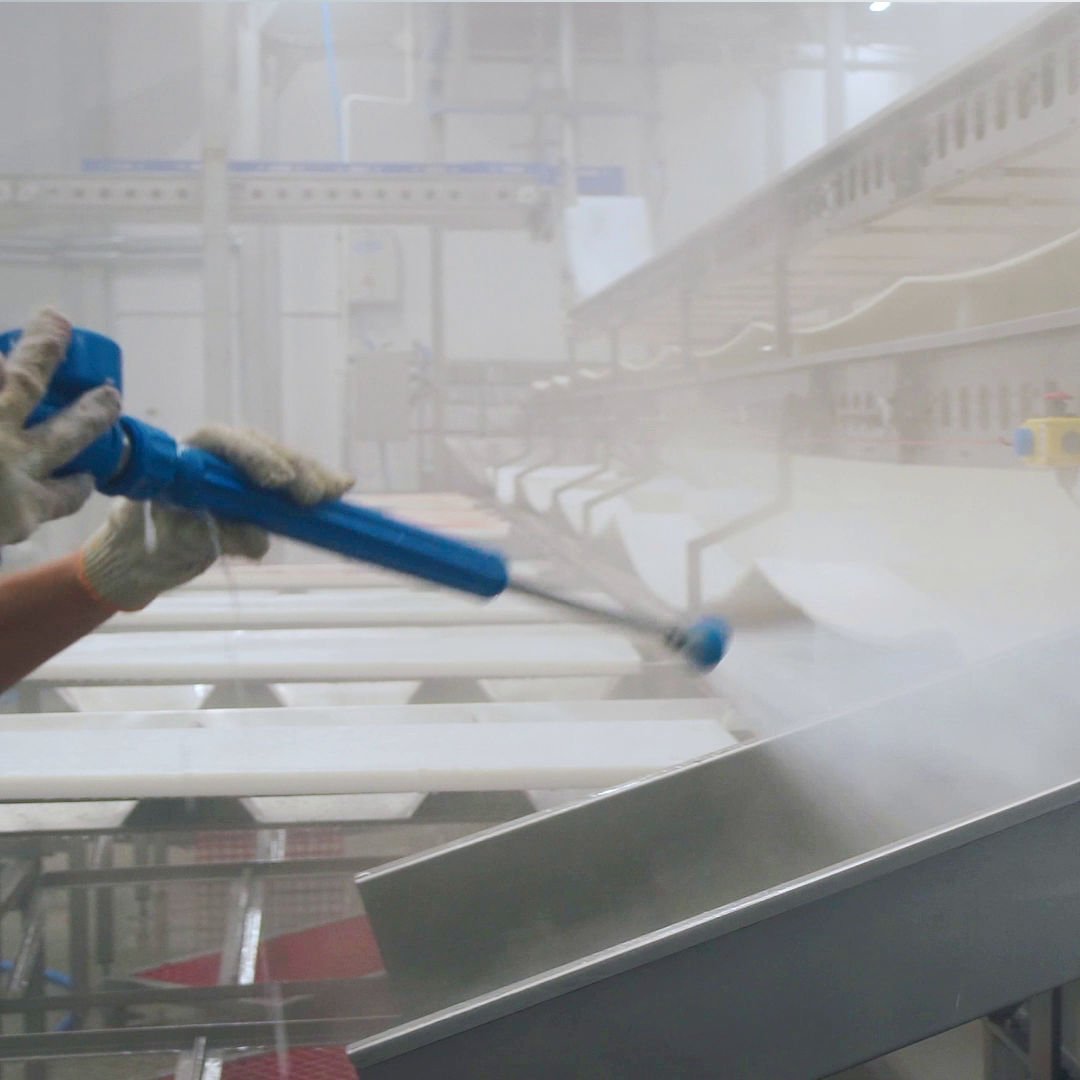
Food manufacturing hygiene has long relied on a toolkit of chemical sanitisers, each chosen for a specific role in the cleaning process. Quaternary ammonium compounds (QUATs), amine-based sanitisers, peracetic acid, and hypochlorous acid are among the most widely used. They all kill pathogens. They all have a place in the market. And they all share a limitation that rarely gets discussed plainly: none of them clean.
Sanitising and cleaning are different jobs. Sanitising kills microorganisms on a surface. Cleaning removes the soils, fats, proteins, and grease that accumulate during food production. A surface that has not been cleaned first will not sanitise properly, regardless of which product you use. This is why the standard food factory cleaning process still runs to five or six steps even when next-generation sanitisers are in use. The sanitiser handles one step. Everything before it stays the same.
eloclear is different in one fundamental way: it does both. This article explains how the most common chemical sanitisers work, what their specific limitations are, and why eloclear represents a different category of solution rather than just another product swap.
The Main Categories of Chemical Sanitiser Used in Food Factories
Understanding what eloclear replaces requires understanding what is currently in use. The most common sanitiser categories in food manufacturing are amine-based sanitisers (including triamines), quaternary ammonium compounds (QUATs or QACs), peracetic acid (PAA), and hypochlorous acid (HOCl). Each works differently and carries different practical implications for the factories using them.
Amine-Based Sanitisers: Effective, But Process-Dependent
Amine-based sanitisers are widely used in food manufacturing, typically supplied by chemical companies as part of a broader hygiene programme. One common example is triamine-based products, such as those containing N-(3-aminopropyl)-N-dodecylpropane-1,3-diamine (also known as laurylamine dipropylenediamine). These are often formulated as no-post-rinse-required sanitisers, which makes them appealing for final sanitising steps where rinsing would add time to the cleaning cycle.
The no-rinse characteristic is genuinely useful in certain applications. But it does not mean the upstream cleaning process is simplified. Like other sanitisers, triamine-based products are applied after cleaning is complete. They do not remove food soils, fats, or proteins. The detergent steps and the hot rinses all happen first. The amine sanitiser is the final step in a process that has not otherwise changed.
There are also questions worth considering about chemical residues on food contact surfaces. The no-rinse designation means residues remain on surfaces after application. For food manufacturers with tight controls on what is acceptable on food contact surfaces, this warrants scrutiny in the context of their specific processes.
QUATs: Widely Used, But Worth Understanding in Detail
Quaternary ammonium compounds (QUATs or QACs) are cationic surfactants and among the most widely deployed sanitisers across food manufacturing, healthcare, and broader industrial hygiene. The most common in food factory applications is benzalkonium chloride, though the QUAT family spans a wide range of compounds with varying chain lengths and functional groups.
The positively charged nature of QUATs is what makes them effective sanitisers: they bind to the negatively charged cell walls of bacteria and disrupt them. But that same positive charge creates a practical issue in food factory cleaning. Most food contact surfaces carry a slight negative charge, and QUATs tend to adsorb strongly to those surfaces. This means residues may not rinse off as completely as assumed, even with thorough post-rinse protocols.
This is not a fringe concern. Research published in peer-reviewed food safety literature has raised questions about QUAT residue persistence on food contact surfaces and its potential implications. It is also worth noting that QUATs require rinsing, unlike some triamine-based products, which adds a process step and further complicates the residue question if that rinse is not thorough.
QUATs are undeniably versatile. The same chemical class is used in hair conditioners (polyquaternium compounds as antistatics), water treatment, and even electronics manufacturing for surface charge modification prior to circuit board metallisation. That versatility reflects genuinely useful chemistry. It also illustrates how varied QUAT behaviour can be depending on formulation, concentration, and the surface they contact. In a food factory, that variability is something engineering and food safety teams should understand rather than assume away.
Peracetic Acid: Effective Across a Wide Range, But Not Without Limitations
Peracetic acid (PAA) is an oxidising disinfectant formed by the reaction of acetic acid and hydrogen peroxide. It is effective against a broad spectrum of pathogens including bacteria, viruses, fungi, and spores, and it breaks down into acetic acid, water, and oxygen, giving it a relatively favourable environmental profile compared to some other sanitisers.
PAA is widely used in food and beverage manufacturing, particularly in CIP (clean-in-place) applications, produce washing, and surface disinfection in high-care environments. Its low-temperature efficacy makes it useful in cold chain environments such as chilled meat processing.
The limitations are practical rather than microbiological. PAA is corrosive at working concentrations, particularly to metals, and requires careful handling and appropriate personal protective equipment. It has a strong, distinctive odour that can be problematic in enclosed environments. Like all the sanitisers covered in this article, PAA is deployed after cleaning: it kills pathogens on a surface but does not lift or emulsify food soils. The upstream cleaning steps remain in place. Its cost per litre is also higher than many alternative sanitisers, which matters at the volumes food manufacturers typically use.
Hypochlorous Acid (HOCl): A Better Sanitiser, Not a Better Process
HOCl is a chlorine-based disinfectant generated by electrolysing salt water. It kills bacteria, viruses, and yeast rapidly at low concentrations through a well-understood mechanism: as a small, electrically neutral molecule, HOCl crosses bacterial cell walls and membranes via passive diffusion, then acts as a potent oxidant that disrupts calcium ion channels, mitochondrial function, and critical biomolecules including proteins and lipids. The result is rapid, broad-spectrum cell death.
The limitation of HOCl is not its sanitising performance. The limitation is that it is only a sanitiser. HOCl is acidic by nature, which means it has no detergent properties and cannot lift fats, proteins, or food soils from surfaces. Surfaces still need to be cleaned before HOCl is applied, meaning the full upstream cleaning process stays intact. HOCl enters at the final step and improves that step. The rest of the process is unchanged.
There is also the corrosion question. Early HOCl systems operating at acidic pH caused well-documented problems with stainless steel equipment. Some HOCl suppliers claim their product does not require rinsing from food contact surfaces, but residual chlorine species are highly corrosive and known to cause pitting corrosion on the austenitic stainless steels most commonly used in food manufacturing, including grades 304 and 316. This claim warrants scrutiny by any engineering team evaluating the technology.
HOCl is a meaningful improvement over some older chlorine-based chemistries. But it does not change the cleaning process, and that is where most of the cost in food factory hygiene actually lives.
What All These Sanitisers Have in Common: They Are the Final Step
The pattern that runs across amine-based sanitisers, QUATs, peracetic acid, and HOCl is that they are all deployed at the end of a cleaning process that has not otherwise changed. A standard open plant cleaning process in a food factory typically involves:
- A hot water pre-rinse to remove loose soils
- An alkaline foam detergent stage to lift fats and proteins
- A hot water rinse to remove detergent residue
- A sanitiser application
- A final rinse (where a post-rinse sanitiser is used; no-rinse formulations omit this step)
Switching between sanitiser products at the sanitiser step does not affect any of the steps before it. All the cost and time embedded in those steps (the water heating, the chemical purchasing and handling, the rinse cycles, the downtime) stays in place. For food manufacturers who are genuinely trying to reduce cleaning costs, water use, energy consumption, or chemical inventory, a sanitiser swap is not the lever that moves those numbers.
Does Cleaning With a Detergent Actually Have to Come First?
Conventional hygiene protocols specify that surfaces must be cleaned with a detergent before a disinfectant is applied. The logic is sound: disinfectants work more effectively on clean surfaces with reduced organic load. But the assumption that a detergent specifically is required has been challenged.
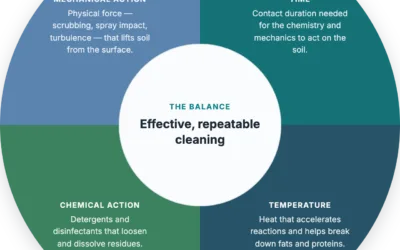
Effective cleaning prior to disinfection can be described using what is known as Sinner’s Circle: the four variables that influence a cleaning operation are process time (including contact time), chemistry concentration and type, application temperature, and mechanical or physical action. Crucially, these variables interact and can compensate for each other. Water alone, applied at sufficient temperature, pressure, and contact time, can remove the bulk of surface organic load, particularly where gross debris has already been removed.
OZO Innovations successfully argued this case before European regulatory authorities, submitting evidence to support the removal of the mandatory specification for detergent use prior to eloclear application. The submission drew on the principle that there is no robust scientific evidence requiring detergents specifically, as opposed to effective pre-cleaning by other means, as a precondition for disinfection. The regulatory outcome was that eloclear does not require a prior detergent step, provided gross debris is removed and surfaces are visually clean, a position consistent with established risk mitigation measures (RMMs) applied to other approved biocidal active substances under the EU Biocidal Products Regulation (BPR).
This is practically significant. It means eloclear can reduce the cleaning process not just by replacing the sanitiser step, but potentially by removing the detergent step altogether in certain applications, which is where a substantial portion of chemical cost, rinse water demand, and process time is concentrated.
What eloclear Does Differently
eloclear is produced through membrane-free electrolysis of salt and water, generating a mildly alkaline solution at around pH 9. That pH profile is what makes the structural difference. At a mildly alkaline pH, eloclear actively removes food soils, fats, and proteins from surfaces while simultaneously disinfecting. It is a cleaner and a sanitiser in a single application.
That dual action allows food manufacturers to remove entire steps from the cleaning cycle rather than improving one step at the end of an otherwise unchanged process. The compression of process steps is where the operational and commercial benefits come from.
The chemistry in eloclear is not exotic. It contains both hypochlorous acid and hypochlorite, the same active ingredients already trusted across food hygiene, at a pH that supports cleaning in a way that none of the sanitiser categories above can achieve. The membrane-free generation system is tolerant of industrial water quality and carries lower cost of ownership, with no membrane replacement required.
The Operational Impact of Switching to eloclear
Because eloclear cleans and sanitises simultaneously, the changes it enables are measurable:
Shorter cleaning cycles. Removing steps from the cleaning process reduces the time equipment is offline. More production uptime per shift, or faster turnaround between product runs.
Lower water consumption. Fewer rinse stages means fewer litres consumed per clean. eloclear supports cold water rinsing in many applications, removing the energy cost of heating rinse water.
Fewer chemicals on site. Replacing multiple bought-in chemical products with a single on-site generated solution reduces inventory, simplifies COSHH management, cuts storage requirements, and reduces operator handling exposure.
Cleaner effluent. Fewer chemicals through the process means fewer chemicals in wastewater streams, which matters for sites with onsite effluent treatment and for environmental compliance reporting.
No chemical supply chain. eloclear is generated on site using OZO Innovations’ electrolysis systems from salt and water. There are no drums to order, receive, store, or dispose of.
The Sustainability Case for Changing the Process, Not Just the Product
Every chemical sanitiser on the market can point to some sustainability improvement over whatever came before it. Lower toxicity, reduced packaging, fewer transport miles compared to bulk liquid chlorine. These are genuine improvements at the margin.
It is worth noting that some of these improvements are narrower than they appear. HOCl, for example, when purchased in packaged form rather than generated on site, is essentially shipping water. Unlike traditional concentrated chemicals formulated specifically to minimise transport volume, packaged HOCl solution means moving large quantities of dilute liquid in IBCs and jerry cans, with the associated transport emissions and packaging waste. The same logic applies to other sanitisers supplied in dilute or ready-to-use formats. Concentration matters for the ESG credentials of bought-in chemistry.
eloclear delivers sustainability benefits that are structural rather than marginal, because it changes the process rather than substituting one product in it. Reduced Scope 3 emissions from eliminated chemical supply chains. Lower water abstraction and discharge from fewer rinse stages. Lower energy consumption from reduced hot water demand. Cleaner effluent streams with fewer persistent chemical compounds. Fewer plastic drums and IBCs in the waste stream.
For food manufacturers with committed ESG targets, the difference between incremental improvement and structural change is significant. Swapping a QUAT for a triamine, or a triamine for peracetic acid, does not move the dial on water, energy, or process time. Removing steps from the cleaning cycle does.
Evaluating Whether eloclear Is Right for Your Process
The starting point is an honest look at your current cleaning process: how many steps, what products, what water temperatures, and what total cleaning time looks like across your lines. If you are running five or more steps, purchasing multiple chemical products, and experiencing meaningful production downtime from cleaning cycles, eloclear is worth a direct evaluation.
The shift is not about product cost in isolation. It is about the full cost of the cleaning process: labour, water, energy, chemical purchasing, storage, effluent treatment, and downtime. When those costs are mapped against what eloclear enables, the case tends to be clear.
Speak to the OZO Innovations team to see how eloclear compares to your current process and chemistry mix.