In January 2026, two of the most respected names in green chemistry, Professor Bruce Lipshutz of UC Santa Barbara and Professor Sachin Handa of the University of Missouri, published a paper in the journal Green Chemistry with a fairly blunt message: the 12 Principles that have guided sustainable chemistry since 1998 need an overhaul, and time is running out to act on them.
If you work in food manufacturing, facilities management or sustainability, you might be wondering why a chemistry journal paper matters to you. Here’s why: the original 12 Principles, written by Paul Anastas and John Warner nearly 30 years ago, quietly shape an enormous amount of what gets called “sustainable” or “green” today, including the cleaning and disinfection chemicals used in your factory. When the people who wrote the rulebook decide it needs rewriting, it’s worth paying attention.
So what’s actually changed, and what does it mean if you’re responsible for hygiene processes in a food production environment? Let’s break it down.
Why the Original 12 Principles Needed Rethinking
The original Principles were aspirational. They were written at a time when “green chemistry” was a niche idea, and the hope was that within a few decades it would become standard practice across the chemical industry.
Nearly 30 years on, Lipshutz and Handa argue that hasn’t really happened. Many labs, suppliers and manufacturers still haven’t meaningfully adopted these principles, and the chemical industry remains a significant contributor to global emissions. Meanwhile, the world has changed. Climate change has gone from a future concern to a present reality, PFAS and “forever chemicals” have become a mainstream issue, and ESG reporting has shifted from optional to mandatory in many sectors.
The paper’s central argument is that the 12 Principles need to go from being a list of nice ideas to a genuine call to action, with a stronger focus on measurement, accountability and learning from nature’s own chemistry.
What’s New in the 2026 Principles
A few changes stand out as particularly relevant if you’re thinking about hygiene and cleaning chemistry.
Principle 1 has been sharpened.
“Waste Prevention” becomes “Do Not Create Waste!” The wording change might look small, but the intent is clear: this isn’t a suggestion anymore.
Solvents and reaction media get a new emphasis.
The updated Principle 2 states plainly that water is the safest possible reaction medium, quoting the well-known green chemistry maxim: the best solvent is no solvent, and if a solvent is needed, water is preferred.
Toxicology gets its own principle for the first time.
The new Principle 9, “Be Mindful of Toxicological Issues,” asks practitioners to think from the design stage about whether a product could become a pollutant, and how easily it breaks down into harmless substances if it ends up in waste streams.
Metrics finally get formal recognition.
Principle 10, “Don’t Forget Metrics!”, is a direct response to what the authors describe as a real problem in the industry: claims of being “green” or “sustainable” that aren’t backed up by actual measurement. The paper points out that without tools like E-factors, process mass intensity or life cycle assessment, sustainability claims can’t be trusted, and may even be the opposite of what they claim.
And perhaps most strikingly, the new Principle 11 asks chemists to follow nature’s lead.
The paper notes that nature has been “doing chemistry” for over four billion years, almost entirely in water, at ambient temperatures, without a drop of petroleum. The challenge to modern chemistry is to ask: how would nature solve this problem?
What This Means for Cleaning and Disinfection in Food Manufacturing
Industrial hygiene isn’t usually the first thing people think of when they hear “green chemistry.” But it’s one of the areas where these principles map most directly onto everyday operational decisions.
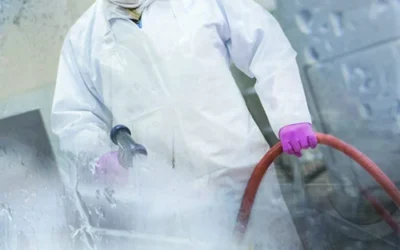
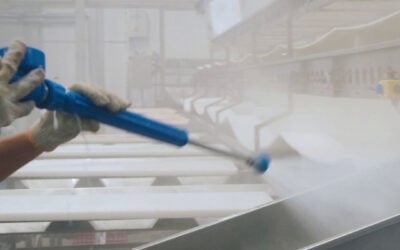
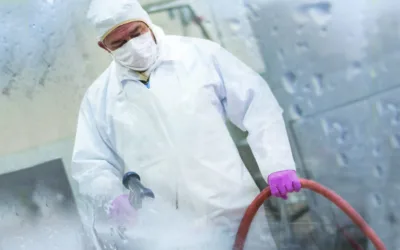
Think about a typical cleaning and disinfection process in a food factory. There’s a chemical concentrate, often delivered in IBCs or jerry cans, often manufactured off-site and transported in. There’s dilution, sometimes with hot water heated specifically for the rinse cycle. There’sThere are the chemical products themselves, which may contain surfactants, sequestrants, or other auxiliary ingredients. And at the end of it, there’s an effluent stream containing all ofall that chemistry, which has tomust be treated or discharged.
Run that process against the 2026 Principles and a few questions naturally come up. Where is waste being created, not just in the product itself, but in the packaging, the transport, and the effluent? Is water being used as the primary medium, or are organic solvents and harsh auxiliaries still part of the mix? Could the active ingredient become a pollutant, and how readily does it degrade? And critically, can any of this actually be measured?
This is where electrochemically generated products, like eloclear, start to look like a genuinely interesting case study.
Made From Salt and Water, Generated On Site
eloclear is produced on site from just food-grade salt and cold water, using an electrochemical process. There’s no off-site manufacturing of the active chemistry, no transport of concentrates, and no IBCs or jerry cans to dispose of. That alone addresses several of the waste and transport concerns at the heart of the new Principle 1.
The chemistry itself happens in water, at ambient or even cold temperatures, with no organic solvents and no hazardous auxiliaries. That’s about as close as you can get to the “best solvent is no solvent, water if you must” guidance in the updated Principle 2.
It’s also worth noting what eloclear doesn’t contain. No surfactants, no chelating agents like EDTA, no co-formulants or stabilisers. At a pH of around 8.8 to 9.2, it’s significantly milder than the caustic detergents typically used at around pH 13, while still delivering the disinfection performance needed in food environments.
The Toxicology and Metrics Questions
This is where the new Principle 9 becomes particularly relevant. eloclear has been independently tested by UKAS-accredited laboratories for antimicrobial efficacy against bacteria, yeast, fungi, mould and enveloped viruses including SARS-CoV-2. On the toxicology side, the generation process is optimised to minimise by-products like chlorate, and the specific cell architecture used eliminates perchlorate, an endocrine disruptor that can be a concern with some electrolysed water systems.
It’s also designed for facile degradation, which is exactly what the updated Principle 7 calls for. As a reactive oxidiser, it’s consumed during use and naturally decays back into salt and water, the same materials it started as.
Then there’s Principle 10, the “don’t forget metrics” principle. This is arguably where the gap between marketing claims and genuine sustainability gets exposed in most industries. A structured deployment approach, capturing baseline data before implementation and verified results afterwards, means water reduction, energy savings and CO2e reductions can actually be measured and reported using recognised methods like UK government conversion factors, rather than estimated or assumed.
Following Nature’s Lead
Perhaps the most interesting connection is to the new Principle 11, the call to innovate by following nature’s example.
Hypochlorous acid isn’t some exotic synthetic chemical. It’s the same class of oxidant that white blood cells in the human body produce naturally to fight off infection. The electrochemical process that generates eloclear essentially recreates, at a useful scale, a piece of chemistry that nature has been running inside living organisms for a very long time.
That’s a genuinely good fit with what Lipshutz and Handa are calling for: chemistry that takes place in water, at ambient temperatures, using a mechanism nature already relies on, rather than a synthetic alternative that needs to be manufactured, packaged, transported and eventually disposed of.
What This Means Going Forward
The publication of this paper doesn’t change anything about the cleaning chemicals sitting in your factory today. But it does give procurement teams, sustainability leads and operations managers a useful new lens for evaluating them.
Next time someone in your supply chain describes a product as “green” or “sustainable,” it might be worth asking how it stacks up against these updated principles. Is it generated from abundant, simple inputs? Does it avoid hazardous solvents and auxiliaries? Does it degrade safely? And, critically, is there actual data behind the claims, or just the word itself?
These aren’t abstract academic questions anymore. As the authors put it, time is running out, and the principles guiding green chemistry need to become a call to action rather than a list of good intentions sitting in a textbook.
If you’d like to talk through how this thinking applies to your own hygiene processes, get in touch with the Ozo Innovations team.