A food recall costs, on average, £10 million.
That figure doesn’t include reputational damage, retailer delisting, or the months of recovery that follow. Yet right now, across UK food manufacturing, companies are quietly cutting the very hygiene teams that stand between them and that outcome.
The reasoning is understandable. Employer National Insurance contributions rose to 15% in April 2025, with the secondary threshold slashed from £9,100 to just £5,000. This has compounded a related pressure: the National Living Wage rose 6.7% in April 2025 to £12.21, then a further 4.1% in April 2026 to £12.71. For food manufacturers, this has done more than raise the wage floor, it has compressed pay differentials throughout the lower half of the salary structure, as staff just above the minimum see their differential shrink and pressure builds to re-grade multiple layers of the workforce.
or labour-intensive food businesses employing large numbers of shift workers, the combined cost impact has been immediate and significant. Around half of businesses surveyed said they were looking at reducing hours, overtime, or staff headcount in response to the NI changes. In food manufacturing, where margins are thin and payroll is the dominant cost line, hygiene operatives are often first in the firing line.
This is a short-sighted calculation. And with tightened Listeria legislation coming into force in July 2026, it may prove to be a very costly one.
The Listeria Legislation Change That Changes Everything
Most food safety teams are already familiar with the Listeria monocytogenes criteria under Regulation (EC) 2073/2005. What’s changing from July 2026 is the point at which compliance is measured.
Under the current rules, the “not detected in 25g” criterion for ready-to-eat foods that can support Listeria growth applies only while the product is under the manufacturer’s direct control. From 1 July 2026, that criterion must be met across the entire shelf life of the product, even after it has left the factory floor and entered the supply chain. The responsibility also expands beyond the producer, meaning food business operators throughout the supply chain carry compliance obligations.
The practical consequences for affected categories are significant. Manufacturers of cold-smoked fish, cooked meats, RTE sandwiches, soft cheeses, and frozen ready meals face the greatest exposure. Those exporting to the EU or supplying Northern Ireland have no choice: compliance is mandatory. And given that the UK Food Standards Agency is closely aligned with EU food safety standards, even businesses focused solely on the GB market should treat July 2026 as a planning horizon, not a safe boundary.
What this means operationally is that absence of Listeria at point of production is no longer sufficient. The entire production environment, from drainage and surfaces, to walls, floors, and processing equipment, needs to be clean enough that contamination risk is genuinely controlled rather than documented and hoped for.
Listeria establishes itself in floor drains, behind poorly maintained kerbs, in cracked tiles, and anywhere moisture and organic matter can accumulate. Poor hygiene practice doesn’t just fail an audit; it creates reservoirs that persist and spread.
Cutting hygiene headcount in this context isn’t cost management. It’s risk accumulation.
NI Increases and the Hidden Cost of Under-Investment
The NI changes have squeezed food businesses in ways that are still unfolding. The lower secondary threshold hits particularly hard for companies reliant on part-time or lower-wage workers, a large proportion of the cleaning and hygiene workforce in UK food manufacturing. A part-time hygiene operative who previously attracted no employer NI liability now triggers contributions from just £5,000 of annual earnings.
The response from many boardrooms has been predictable: reduce FTE, reduce shifts, and assume the remaining workforce will absorb the shortfall. What doesn’t appear in those spreadsheets is the counterfactual cost, the product recall that didn’t happen yet, the environmental swab that hasn’t come back positive yet, the FSA notification that hasn’t arrived yet.
A product recall doesn’t just cost the direct recall and destruction expense. It costs market access. In categories like smoked salmon or prepared salads, a single Listeria incident can end a retail relationship that took years to build. The financial logic of protecting hygiene investment looks very different once those downstream costs are included in the model.
The smarter response to rising employment costs isn’t fewer hygiene operatives. It’s hygiene processes that are more effective with every operative hour deployed, which is precisely where technology-led sanitation comes in.
The food manufacturing sector is in the middle of a genuine transformation. Automation is moving beyond production lines and into hygiene operations. Real-time environmental monitoring systems now track microbial risk across facilities continuously, flagging deviations before they become contamination events. CIP (Clean-in-Place) systems are being integrated with data platforms that record, audit, and optimise every clean cycle. Sensor-driven dispensing is replacing manual chemical dosing, removing human variability from the equation entirely.
This isn’t future-gazing. These systems are commercially available and being deployed by leading manufacturers today. The shift from reactive to preventive sanitation, informed by data, driven by consistency, is one of the defining operational changes of the next five years.
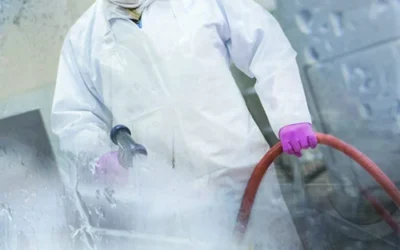
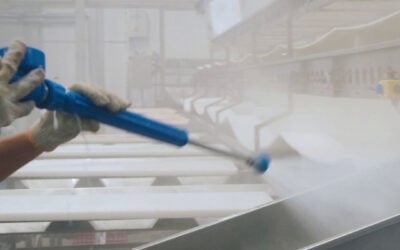
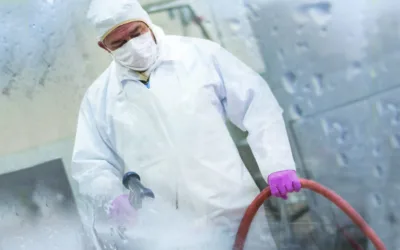
One practical example of this shift is the move toward smart rinse and dosing systems that capture data at the point of cleaning. Rather than relying on manual records or periodic audits to verify that open-plant cleaning has been carried out correctly, these systems generate real-time, auditable data on every clean, what was applied, what concentration, for how long. For food manufacturers facing increasing scrutiny from both regulators and retail customers, that shift from assumed compliance to evidenced compliance is significant.
Ozo’s smart ring main approach brings exactly this capability to open-plant cleaning, giving hygiene teams data-driven insight into every clean cycle and giving operations and technical managers the audit trail they increasingly need.
Within this context, the chemicals themselves are also under scrutiny. ESG reporting requirements, Science-Based Targets, and mandatory climate disclosures are pushing food businesses to examine the environmental footprint of their cleaning regimes. Chemical hygiene products carry procurement, transport, storage, handling, and disposal costs, many of which are invisible in simple per-litre comparisons. Water consumption, chemical residues, and effluent load are increasingly factors in sustainability reporting, retailer audits, and long-term operational cost modelling.
Sustainability Mandates Are No Longer Optional
The Task Force on Climate-related Financial Disclosures (TCFD) became mandatory for large UK businesses in 2023. Science-Based Targets (SBTi) commitments are being built into supplier codes of conduct by major retailers. For food manufacturers trying to maintain or grow their retail listings, the question of how they sanitise their facilities is no longer just a food safety conversation. It’s an ESG one.
Traditional chemical disinfection regimes carry a significant environmental burden, from the carbon footprint of manufacturing and transporting concentrated chemicals to the effluent load they create at the other end of the process. Reducing or eliminating chemical inputs from cleaning programmes is an increasingly viable pathway to meaningful sustainability gains, not just greenwashing.
The automation of hygiene also reduces human exposure to hazardous substances, which has its own regulatory and operational benefits as workplace health standards continue to tighten.
What Future-Ready Sanitation Actually Looks Like
The manufacturers best positioned for 2026 and beyond share some common characteristics. They’re moving away from hygiene as a labour-intensive, chemically dependent operational activity and toward sanitation as a controlled, measurable, consistently delivered process. They’re using data to manage hygiene performance rather than relying on manual record-keeping and periodic audits. And they’re deploying technology that makes their cleaning programmes more effective, more sustainable, and less dependent on headcount.
This is the exact problem Ozo Innovations was built to solve.
Ozo’s eloclear technology transforms salt and cold water into a combined cleaner and disinfectant solution through electrolysis, simple, benign ingredients producing greener, safer chemicals on demand. It has been independently verified for efficacy against bacteria, yeast, fungi, mould, and viruses.
And while adopting eloclear does involve a change to how hygiene teams clean day to day, it integrates into existing workflows without requiring a wholesale operational overhaul. Ozo works closely with a site’s technical and hygiene functions to embed eloclear into current cleaning processes, rather than offering it as a straight drop-in replacement.
The environmental credentials are substantive: in-situ production eliminates the need for externally manufactured chemicals and their packaging, no transport of hazardous materials, reduced water consumption, cleaner waste effluent. For businesses navigating TCFD reporting and SBTi commitments, that matters in ways that traditional chemical suppliers can’t match.
For businesses facing the Listeria legislation change, the consistency of eloclear is particularly relevant. A sanitation outcome that depends on the right chemical being ordered on time, stored correctly, dosed accurately, and applied consistently by a rotating shift workforce is a fragile system.
The Calculations Are Changing
The food manufacturing sector is facing a genuine inflection point in 2026. Regulatory pressure is increasing. Employment costs are rising. Sustainability expectations are tightening. And the legislation underpinning food safety is becoming more demanding across the shelf-life chain.
The businesses that will navigate this well aren’t the ones making the cheapest short-term decisions. They’re the ones asking a harder question: what does a genuinely future-ready hygiene operation look like, and how do we get there?
Ozo’s answer is smarter, sustainable, chemistry-free sanitation, which was designed for exactly this moment. If you’re rethinking your hygiene strategy for 2026 and beyond, explore how eloclear can work in your facility or speak to our team about a site assessment.